
Dirtying the Word

Have to admit, had to look it up. I was taking part in a panel discussion in a bookstore with three other authors. During the back and forth, one of them turned to me and asked if my novel is an allegory. Couldn’t remember ever using the word, too fancy for my tastes. Unsure of its meaning, I skirted the question. Can’t recall my exact words, but my answer was something along the lines of wanting readers to judge for themselves.
I did indeed look it up after the event. One dictionary defines allegory as “the expression of truths or generalizations about human existence by means of symbolic figures and actions.” Another says it’s a story “in which the apparent meaning of the characters and events is used to symbolize a deeper moral or spiritual meaning.” A third gives this highfalutin description: “A representation of an abstract or spiritual meaning through concrete or material forms; figurative treatment of one subject under the guise of another.”
When I sat down to write Miracles Along County Q, I wasn’t saying to myself how cool it would be to whip up a good allegory. Just wanted to pay tribute to my late brother Dan. Suspected a straight biography would struggle to find an audience. Lacked confidence in my ability to get across in a biography the miracles Dan worked on his younger brother, the magical effect he had on me. Settled on a fictionalized account of his life story. May have stumbled on writing an allegory in the process, without knowing it.
Wasn’t trying to make some grand moral or spiritual point, under any guise, abstract or concrete. Was simply trying to spin a good yarn and repay a debt I owed Dan. I am not a churchgoing man, and neither was he. Once gave him this shirt as a birthday present bearing the inscription: “Lead me not into temptation. I can find it myself.”
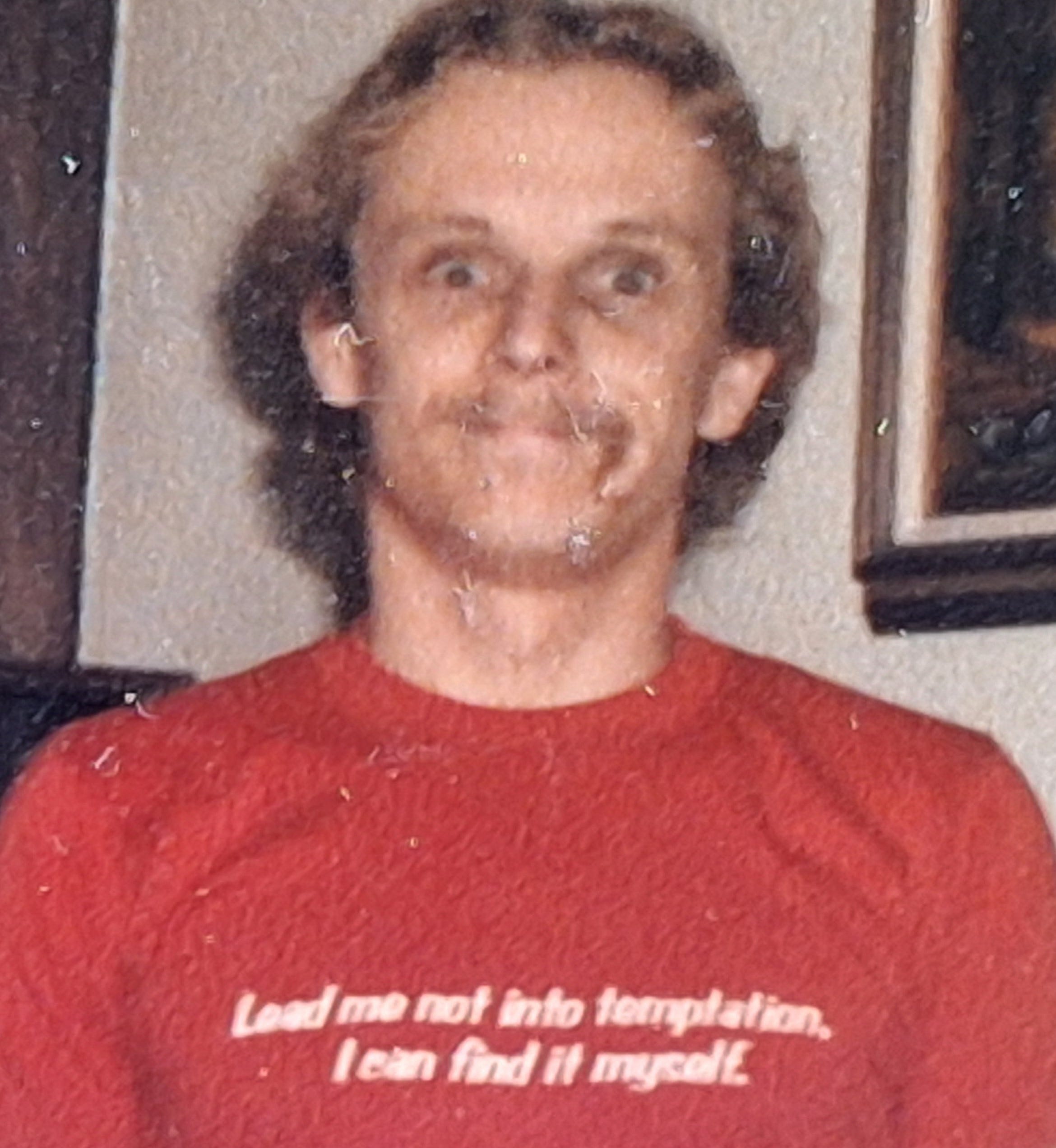
Dan loved that shirt, wore it ragged. He was no saint, far too devilish to qualify. His passion was hunting, loved guns, drove recklessly, drank too much, was a meat-eater to the point of gluttony. Another dimension of his lived experience altered the course of my life, put me on a path I fear I never would’ve taken if he hadn’t been my brother. Opened my eyes, made me a better, more compassionate, more principled man than I ever could have become flying blind. Weird how he inspired me to write a story another author called “a parable for our troubled times.” Parable, another one of those churchy words. Dan would get a good laugh from that if he were still with us.
Labels like allegory and parable surely scare off some readers. Among the secular, these are loaded terms, off-putting ones. They see too much hypocrisy in worship. It’s been seen for ages. Hell, Mark Twain once wrote, “If Christ were here now, there is one thing he would not be—a Christian.” Near the end of Miracles Along County Q, one of the central characters—old man Morger—says: “For all the worshipping going on, there’s very little faith, certainly not in each other, not even in a power higher than ourselves. I swear, if a second coming actually happened, the messiah wouldn’t be persecuted, wouldn’t be crucified. Would be overlooked entirely, I’m sure of it.”
Setting my novel in a fictional Wisconsin town named Faith was a deliberate choice, one that undoubtedly put off a few more readers. Chose it because of what’s being lost, what’s gone missing in too many lives. Like a thousand Faiths scattered throughout the country, faith is withering in America. It’s shriveling because it’s not properly understood, and that miscomprehension is causing it to be downsized.
Faith is equated to piety, but the two are not synonyms. When I say I am a man of faith, I am not proclaiming a religious bent. Faith is far more ambitious than that. Faith is not merely worship; it’s a deep understanding of the importance of belief in what’s possible. I have faith in democracy, which means I believe in my fellow citizens. I have faith in humanity, meaning I believe in the goodness in people despite an abundance of familiarity with cruelty and savagery.
We have invented machines that can gather information far faster than we can, write faster, calculate faster, make things faster. As intelligent as we’ve made them, they are not capable of empathy or generosity. They do not have faith, nor do they possess faith’s sibling, imagination. They only know what is, not what could be. They can sift through a hundred information sources, or a thousand, or a million, in a matter of seconds, then give you an answer. They cannot imagine a previously unfathomed possibility, or believe in it.
Faith is imagination, imagination is an act of faith. Nothing is more central to what it means to be human. Nothing is more intelligent.