
The Makeup's Coming Off

Maybe she’s born with it, maybe it’s Maybelline. This advertising catchphrase from a cosmetics industry giant comes to mind when thinking of one of my pet peeves, namely the color coding of states and communities to indicate their ideological leanings and party preferences. To say a place is Republican red or Democratic blue is not a reflection of reality, it’s a thick application of makeup concealing underlying complexities and ever-evolving tastes.
This color coding is done and tolerated despite two fairly obvious truths. First, coloring a place red or blue implies everyone there shares the same partisan affinity when, of course, substantial numbers—sometimes perilously close to half—prefer the other party. Even saying that doesn’t factor in the large number of people who dislike both major parties and thirst for some alternative.
Second, party affiliations are not set in stone, they are fluid. Our Republican president won the county where I grew up by over 30 percentage points in 2016 and by more than 40 percentage points in 2024. Democrats represented the area when I was young.
America is now in the early stages of a seismic generational shift in political values and identification. The number of young Americans with a positive view of capitalism is down nearly 20 percentage points from a decade earlier. Meanwhile, nearly two-thirds of the youngest adult generation views socialism favorably. Right-wingers are unnerved to say the least.
The greed-is-good crowd flails wildly in trying to explain this development. They howl about how social media is radicalizing our nation’s youth. They whine that Gen Z is ignorant of how “the blame assigned to capitalism really belongs to the growth of socialism.”
A few right-of-center types are more measured in their assessment of Gen Z’s politics, allowing for the possibility that “they don’t like vast income inequality and all the human suffering that comes with it.” You think?
At least one let himself venture even further afield: “Young people today are not radicals. They are pragmatists frustrated by broken promises. They still value individual liberty, innovation and the ability to build a better life. What they’re rejecting is the version of capitalism they’ve seen in practice — a system they perceive as rigged, extractive and unresponsive to ordinary people.” Ding ding ding!
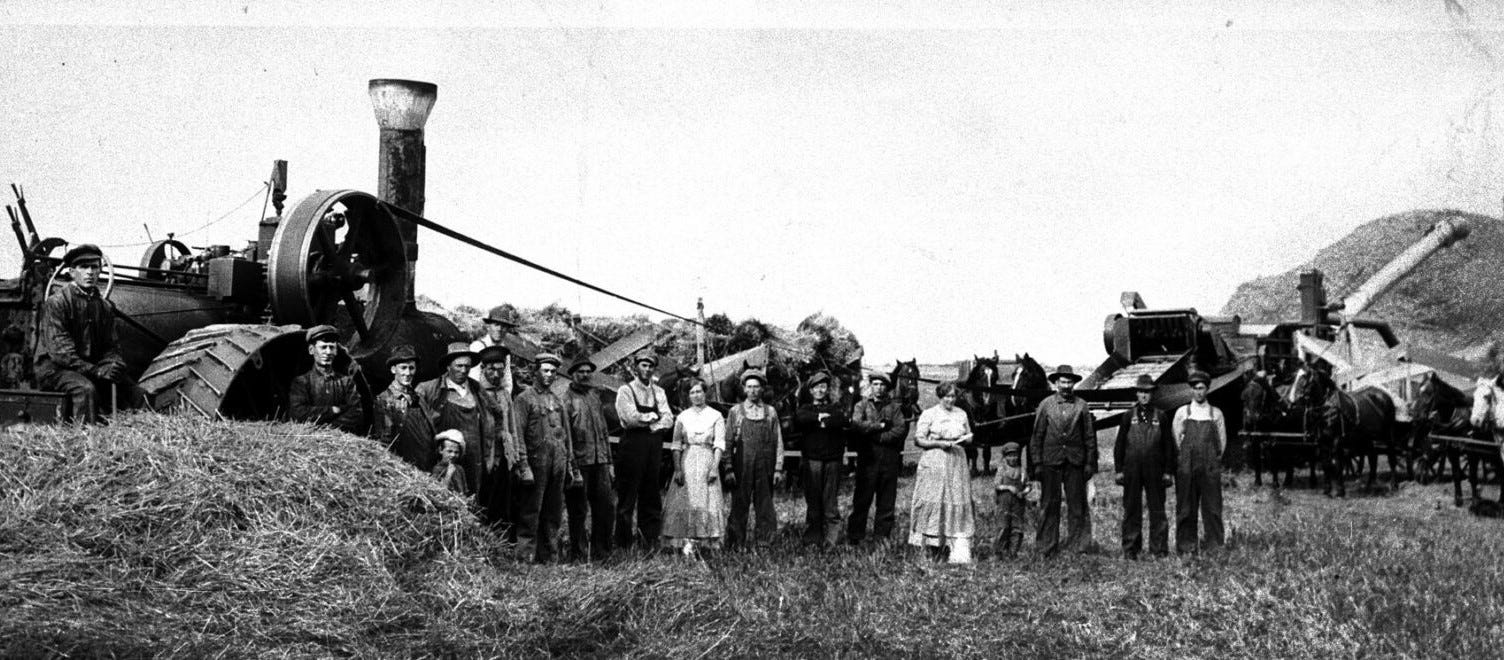
This is nothing new. Capitalism’s excesses have fueled growth in socialism’s popularity before, even in places that today get painted bright red. One hundred ten years ago, farmers in North Dakota were at wit’s end about the insensitivity of elected officials to their economic plight. They were at the mercy of powerful cartels, couldn’t get fair prices for their grain or credit at a reasonable rate. They were paying up to 12% interest. Grain elevators graded grain as lower quality, costing farmers upwards of $55 million a year.
A pair of Socialist Party organizers—flax farmer-turned-political agitator A.C. Townley and farm-raised teacher Albert Bowen—enlisted tens of thousands of followers eager to get out from under the thumb of out-of-state tycoons who were gouging them. Farmers in North Dakota were sensible pragmatists, not ideologues. They did not want to be labeled as radicals, subversives, or members of the Socialist Party. But they also weren’t afraid to embrace “socialist” solutions to their chronic economic problems. Townley and Bowen understood this, and called their newborn political organization the Nonpartisan League. This became the face of socialism in North Dakota.
NPL supporters were called every name in the book, “red Socialists,” expert hypnotists,” “revolutionaries,” “traitors,” “dreamers,” “sweet-mouthed flatterers,” “confidence men,” “anarchists,” “charlatans,” “atheists,” “agitators,” “dynamiters,” “free lovers,” “carpetbaggers,” “home wreckers.”
Townley, Bowen and the legions behind them were undaunted. They put NPL-backed candidates up against those favored by the state’s political machine, and took over North Dakota’s dominant Republican Party in 1916. A wheat farmer and NPL member named Lynn Frazier was elected governor with almost 80% of the vote, and NPL-backed candidates won every other statewide office except one as well as a majority in the state legislature.
Upon gaining power, the NPL acted. Farmers were given credit at significantly lower interest rates through the establishment of the state-run Bank of North Dakota, which opened in 1919 and still operates to this day. A state grain elevator was established by 1922, providing a fair market for grain and a source of feed and seed. Insurance was provided against fire, tornado and hail damage. The NPL gave North Dakota’s women the right to vote, too.
Journalists from across the country entranced by the NPL’s stunning rise to power in North Dakota made pilgrimages to the state, many making fun of the “rubes” and “yokels” who had gained control of North Dakota politics, dismissing them as “tools” of “Boss Townley” and his henchmen. William MacDonald of The Nation had a strikingly different take, writing that the farmer legislators were “…neither visionary theorists nor wild-eyed radicals…. I have seldom observed a state legislature whose controlling majority was so obviously sensible.”
Fast forward a little more than a century, and our nation’s largest city has a democratic socialist mayor who’s similarly making sense and getting things done. Filling over 100,000 potholes and clearing storm drains to protect against flooding. Making landlords and employers pay restitution to tenants and workers. Partnering with the state to roll out the first wave of free child care spots for two-year-olds in historically underserved communities. Laying the groundwork to establish city-owned grocery stores.
Those who are sure this is a one-off might want to think again. The nation’s capital is all but assured to elect a democratic socialist mayor. Looks like America’s second largest city might, too. There’s a good chance we’ll get one as governor right here in Wisconsin, if Gen Z gets its way and panicked establishment Democrats prove unable to hold off the shifting tides by putting their thumbs on the scale for the umpteenth time.
History doesn’t repeat, but it does rhyme. Past generations in red places, blue places, my own home state, sang verses eerily similar to what Gen Z is rapping now. The kind of change brought about before is coming again.
I read in the Economist several years ago that predicted the United States would be very similar to the Scandinavian countries before too many decades--based on the attitudes that the younger generation already was expressing them. I'm all for it!