
The Missing Bill

Their flaws were many, but our nation’s founders were no fools. They crafted an ingenious design, but were not so proud or arrogant to consider it perfect. They built in a mechanism for the design to be altered, and they themselves altered it, barely waiting for the original masterpiece to be on display for all to see before starting to address perceived imperfections.
To these men, owning people with different skin pigmentation was normal, even among those who thought it wrong. Possessing people with different reproductive organs was normal, too. They could scarcely imagine women voting. They didn’t see a civil war coming.
Many other things we take for granted were entirely unknown to them. Electricity. Flush toilets. Motor vehicles. Factories and assembly lines. Furnaces. Air conditioning. Telephones. Radio. Television. Computers. The Internet. Scroll was their word for a piece of parchment, not a mind-numbing way of passing time and ushering doom.
They did not have vaccines, knew nothing of anesthesia, x-rays, antibiotics. Couldn’t dream of airplanes, rocket ships, nuclear reactors, solar panels. But they had sense enough to understand life is forever changing and the world will never be the same. They accounted for that in their design.
Their very first design alteration sought to cement in place five essential freedoms. Two of them—free speech and a free press—today face very real and dangerous threats. A third—religious freedom—is an abstraction to multitudes who’ve fled the church and a blunt instrument for the pious who overlook the fact that it is really two sibling liberties, the freedom to worship and freedom from the imposition of any particular religion. Brother and sister do not walk freely for long unless they walk hand in hand.
The other two of these five freedoms—the right to petition the government for redress of grievances and the right of association that grows out of the freedom to peacefully assemble—are growing weak, like muscles that atrophy when rarely flexed. Other than the mercenaries paid to be couriers for their employers, few Americans bother to communicate their wishes to elected representatives. America once was a nation of joiners. Not anymore. Increasingly small numbers of Americans now act on their fundamental right to join organizations, unions, clubs and other associations to collectively express, pursue and defend common interests.
The founders thought to bestow on us these and other freedoms in the form of a Bill of Rights, but neglected to pass along a second equally valuable bequeath, an accompanying Bill of Responsibilities. They knew no democratic republic would be long for this world without universal education in the ways of citizenship. They took this obligation seriously, we shirk it, having abandoned the task of civic education in our schools to make way for more vocational training and workforce preparation.
We shirk the responsibility to build and nurture community, to an extent that would have left the founders both dumbfounded and dismayed. Without active community building, there is a loss of social connectedness. With that comes erosion of trust. As trust between us declines, fear and division grow. The esteemed social scientist Robert Putnam meticulously chronicled all of this a quarter century ago in his brilliant book Bowling Alone. Putnam slapped a label on the act of joining together in pursuit of common aims. He calls it social capital.
America is now a lonesome place. Joining is no longer in fashion. Our social capital is dwindling and that shrinkage is having all the predictable effects. We have become increasingly fearful and less trusting of one another. As we’ve grown more polarized, our faith in government and other social institutions has evaporated. Defeatism is on the rise. Many if not most Americans seem resigned to the country going downhill. There’s widespread belief that we’re screwed, that our best days are behind us, that democracy is doomed, America’s doomed.
It’s tempting to lay the demise of social capital and our national loneliness at the feet of the pandemic. Tempting, but mistaken. Social disconnection started long before 2020. Symptoms will almost certainly worsen society-wide before they begin to show signs of improvement. This prediction is not based on a gut feeling, it’s based on ongoing study of the behaviors, attitudes and values of the youngest Americans. Social disconnection is noticeable in all age groups, but is most pronounced among the nation’s youth.
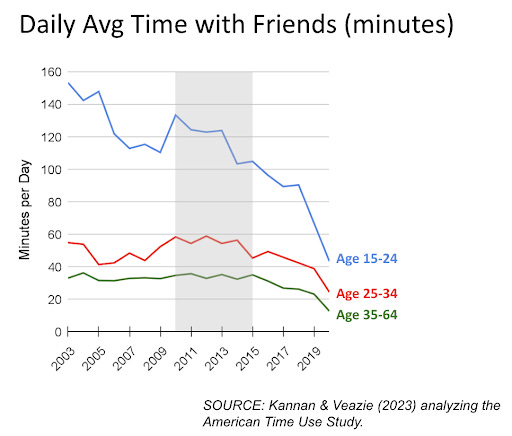
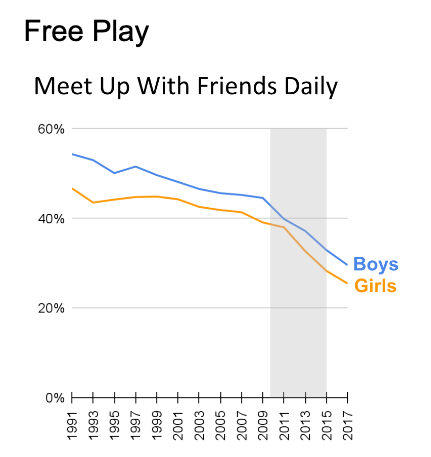
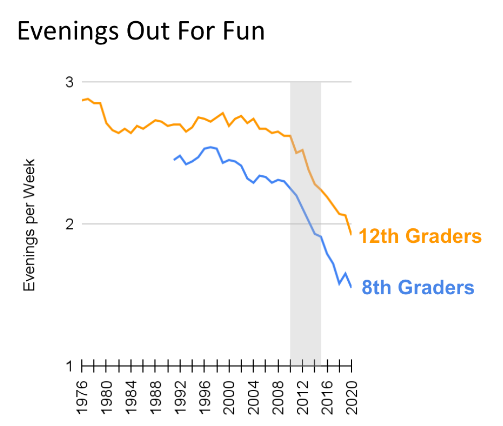
Such dismal trendlines make it tempting to conclude the pessimists and cynics are likely right about the American experiment. Its days must be numbered. One reassuring truth stands in the way of succumbing to the temptation. The founders never lived to see it, and none of us living today were born yet when it happened, but what’s going on today has visited America before. What we’re going through now may be new but it is not unique.
Social capital collapsed before, at the end of the 19th Century on the heels of what was known as the Gilded Age, when robber barons amassed fortunes, built dynasties on the backs and at the expense of working-class masses. Life then was dog-eat-dog. The biggest feasted, the smallest were devoured. Society tore apart. Social cohesiveness was by all appearances dead and gone. Then it came roaring back to life. There was a massive surge in joining.
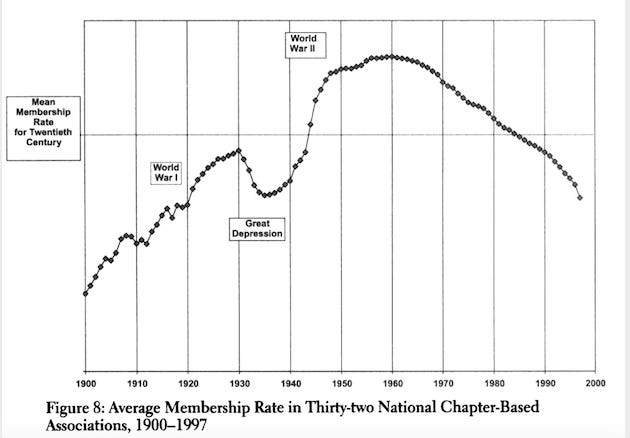
In the span of a single generation at the very beginning of the 20th century, a joining culture emerged and Americans mass-produced social capital. Clubs galore sprung up, Masons, Elks, Moose, Eagles, Lions, Kiwanis, Rotary, Knights of Columbus. Every imaginable kind of group was formed, from the League of Women Voters to the NAACP, fraternities, sororities, Boy Scouts, Girl Scouts, 4-H, AAA, the list goes on and on. As if a dispossessed, downtrodden generation imagined a Bill of Responsibilities.
This is what democracy truly looks like. Some of these groups are surviving if not thriving, most are dead or dying. They all will eventually fall by the wayside, swept away by powerful generational tides. But they will not leave an empty void, at least not for long. Soon enough, growing despair over social disintegration will inspire new formations of social capital. And the world will never be the same. The founders knew that in their day. We’ve temporarily forgotten it in ours.
This really resonates with me. We’ve lost the sense of civic responsibility and community. All the people complaining that No Kings wouldn’t make a difference are wrong . I feel a great sense of community and doing something that is my civic responsibility. We need to keep speaking out and standing up TOGETHER.
Football! That's the foundation of our existence. All life is like a football game Red and blue - fight to win.